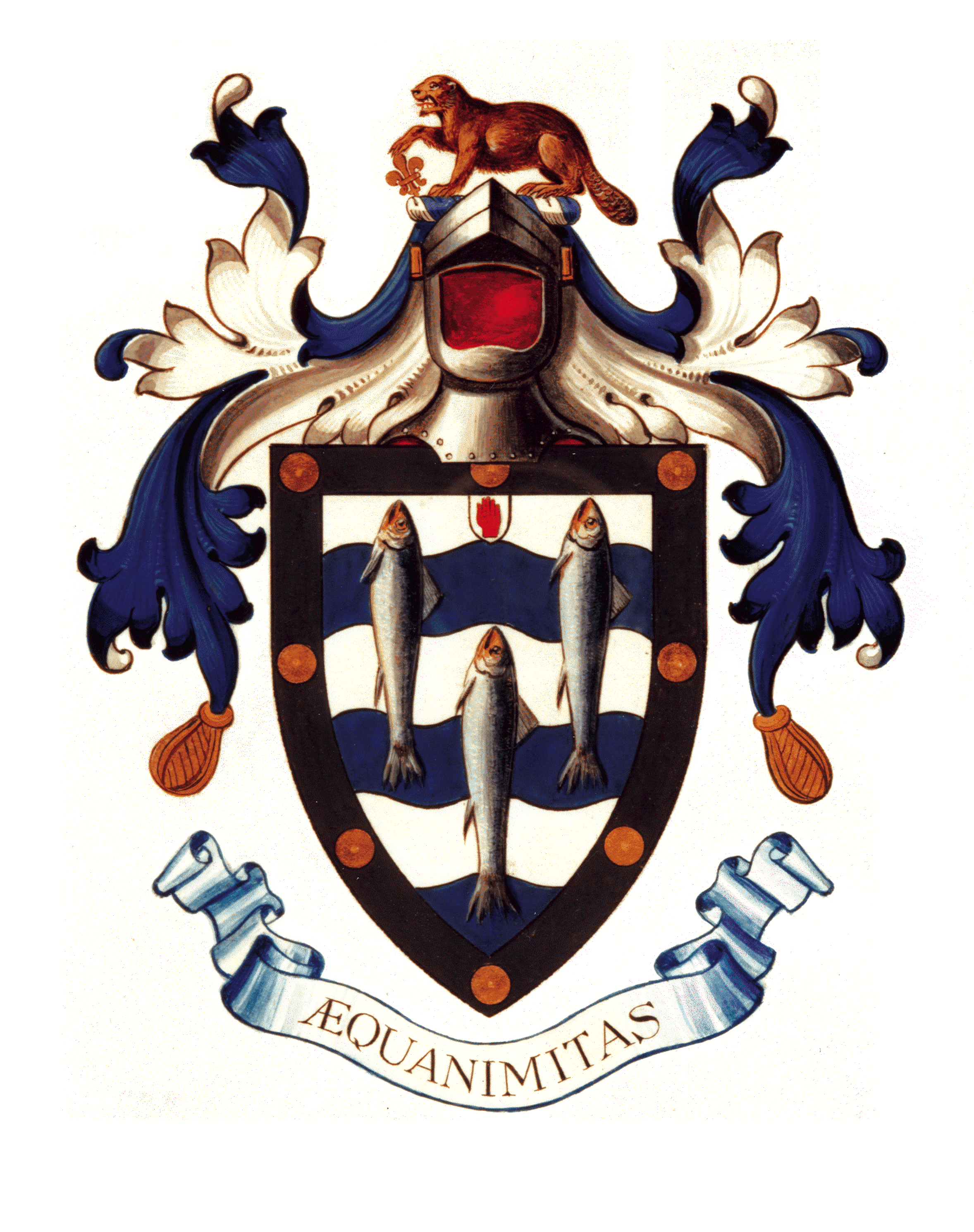
By kind permission of the Osler Library of the History of Medicine, McGill University, Montreal
The College of Arms have looked once again at the wording of the original grant of arms to Sir William Osler, of Norham Gardens in the City of Oxford, Baronet. “On 7 September 1912, Garter, Clarenceux and Norroy Kings of Arms granted him the following arms:
Arms: Barry wavy of six Argent and Azure three Pilchards haurient proper all within a Bordure Sable bezantee
Crest: On a Wreath, A Beaver proper resting the dexter fore paw on a Fleur-de-lis Or
The motto does not form part of an official grant of arms but usually appears in the painting of the arms beside the text on the Letters Patent. For Sir William, the motto was AEQUANIMITAS. The motto can be changed by any family member should they so wish.
The arms were granted to Sir William and all of his legitimate male descendants. However, there was also what is called 'an extension of limitation' to his late father, Featherstone Lake Osler, to include all of the legitimate male descendants of him (i.e. Featherstone). Therefore, if there are legitimate male descendants of Featherstone Lake Osler, the Osler arms are borne by them to this day. However, as the Baronetcy is extinct, the helmet they use would be a gentleman's helm (visor closed, facing to the left) without the baronet's badge (the hand of Ulster) that appears on the shield…“
Source: By kind permission of James Peill, Bluemantle Pursuivant at the College of Arms, London, 27 January, 2026
Sarah Peart, 2026
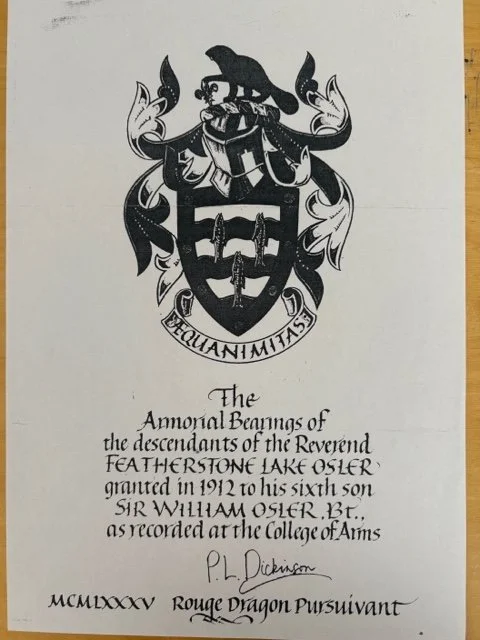
Osler’s Coat of Arms
Osler’s arms were granted in 1911 and are described in Burke’s Peerage of that year as follows:
Arms
Barry wavy argent and azure, three pilchards hauriant proper, all withing a bordure sable charged with eight bezants.
Crest
A beaver proper resting the dexter foot on a fluer-de-lys or.
Motto
Dii laboribus omnia vendunt.
In non-heraldic terms, this can be described as blue and white wavy bars on which are three pilchards in their natural colour with their heads upwards, all within a black border covered with eight gold discs. Above is a beaver in its natural colour with its right paw on a gold fleur-de-lys.
The barry wavy is a common heraldic motif, and in blue and white it represents water. It appears on the arms of the City of Oxford, representing the ford in the Isis, and may be a reference to Osler’s Oxford association. It may equally represent the Atlantic Ocean which divided his two countries of residence, or possibly the river Fal. Osler’s family came from Falmouth, and the pilchard is a type of herring found mainly off the coasts of Devon and Cornwall. The Rev. Featherston Osler, Sir William’s father, went as a missionary to Canada where he was minister of Ancaster and Dundas, Ontario 1857-93. It is interesting to note that the arms of the Ancaster family comprise a red and white barry wavy with three herrings hauriant (head upwards). Osler himself enjoyed angling: in 1908 he went fishing with his son Revere in Scotland.
The bordure and bezants are common heraldic devices but the bezant is sometimes used to represent a pill. In this context three bezants feature on the Medici arms, an obvious pun on the name. They may be fulfilling a similar function here.
Above the shield is the helm with vizor raised affronty, ie. an open-vizored helmet viewed from the front. This represents the steel helm of a baronet and is not mentioned in the heraldic description since it is common to all baronets’, and knights’ arms.
Although beavers had appeared in older heraldry, they were semi-mythical beasts, scarcely recognisable as beavers and often in unfamiliar colours such as blue or green. The beaver in its natural colouring is a comparative newcomer to heraldry. It has been introduced into many recent coats of arms of those in any way connected with Canada. The golden fleur-de-lys is a familiar royal symbol when shown in triplicate on a blue field, but a single one denotes a sixth son. Sir William Osler was the sixth son of Rev. Featherston Osler.
By using them for the tie, the Club is keeping fresh another facet of Osleriana.
Ruth Ward, 1994